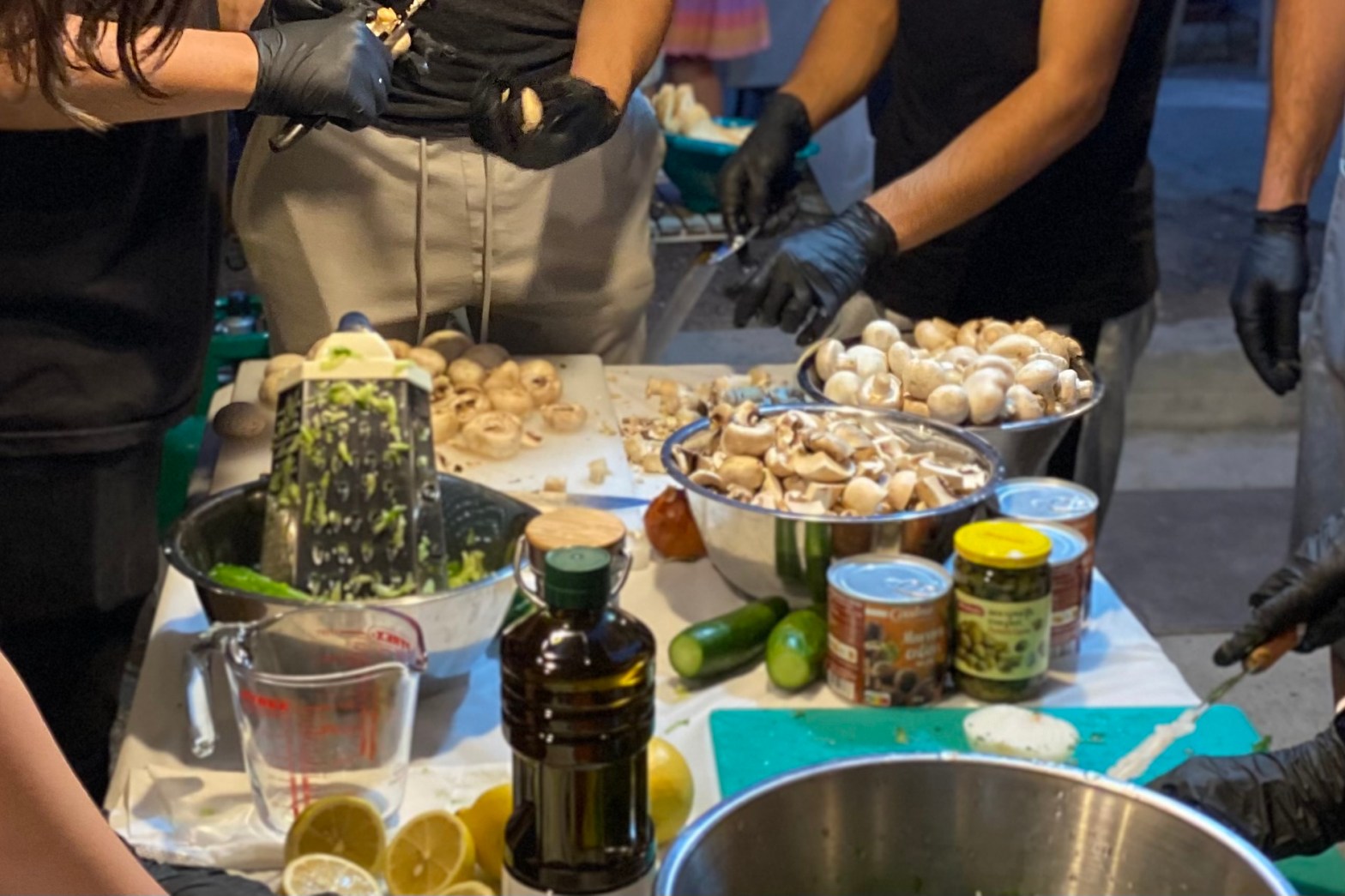
There’s some intuitive appeal to the idea that the experience of cooking and eating is enhanced when we do it together as a group, when we all participate in the different stages of production of a meal from picking and handling ingredients, combining them, seasoning, smelling, tasting to then setting the table, serving and sharing the product of the joint effort.
On closer inspection, however, it’s not all that clear from where the added value stems. Is it the plain fact of togetherness itself? That’s not immediately obvious. How about people eating together in prisons or military barracks or schools? Not only does their togetherness not improve a singularly awful experience but, if anything, it makes it torturous.
In fact, what does it even mean that we perform those acts “together” to start with? Eating is a quintessentially solitary activity. It engages the senses, an unshareable ability par excellence, and satisfies exclusively individual needs or desires. As for cooking, say that a group prepares a meal together and one chops vegetables, another adds spices, a third one stirs and so on, all following a given recipe. This chain activity is cooperative in that everyone shares the same goal but stays on a surface level as each participant contributes something distinct without the involvement of or interaction with others. The end result might, therefore, be more accurately considered not as the product of a joint activity but rather as the aggregative result of parallel actions. Nor does the overall experience seems to have been enhanced. Each participant might draw value from the end result, the meal, to the extent that it meets his or her desire and, possibly, from some sense of pride for having contributed to it but not from the process of having collectively prepared it.
Things begin to get more interesting and promising, when, instead of separating tasks, everyone has some input in all the stages of production including, significantly, the basic components of the dish, which will determine its flavour and appearance. Still, however, we have to wonder why this makes a difference.
It is, of course, the case that cooking and eating as a group can boost a social interaction between friends or strangers by framing it. Food and drink tend to make people content and, all things being equal, content people find it easier to open up to one another and form or strengthen relations. True as this may be, it is still not the result of jointly engaging in an activity but rather of the sense of well-being of individuals.
Might we make more headway by thinking of food as culture? UNESCO defines culture as “the set of distinctive spiritual, material, intellectual and emotional features of society or a social group, that encompasses, not only art and literature but lifestyles, ways of living together, value systems, traditions and beliefs.”[1] Food practices are cultural: “Food lies at the core of human practices, community identity and social scripts. Food belongs to cultural heritage and it is viewed as such as an asset. Each country or community’s unique cuisine can reflect its unique history, lifestyle, values, and culture. Food is an essential part of people’s lives, and as such is much more than just a means of survival. It is also the main factor in how we view others and ourselves.” Not only is it pivotal to the self-understanding and identity of a group, “food culture is as a powerful tool for intercultural dialogue, social inclusion and sustainable development more broadly.”[2]
There is no reason to take issue with any of this. Nevertheless, even if true (and it often isn’t or, at least it’s exaggerated; you might be interested, for example, in how Alberto Grandi debunks myths about “traditional” Italian cuisine),[3] it seems rather unhelpful for our purpose, which is to begin to capture whether engaging in food practices in common adds value and, if so, how. To do this, we would need to take the viewpoint of the participants in the practice. When sitting at a lunch table after a funeral, when layering a moussaka, when placing the fork on the left of the plate and the knife on its right, no one self-consciously thinks of practicing a “culture”, it is simply what they do. In fact, to import an Archimedean understanding reifies the practice and thus potentially undermines its organic evolution. It certainly hinders genuine collective participation, because the “culture” determines the practice rather than the other way around.
I am certainly not going to try to develop a philosophy of cooking and eating together here. Let me only outline what I think is a promising way of thinking about it.
When we cook, we follow a web of rules, social in their origin and the scope of their application and drawn from books and notes or memory, conscious or subconscious. These pertain to every aspect of the process: the properties of ingredients, how to handle them, combine them, at what temperature to cook them at and in which pots and pans, what to do with leftovers and waste. The practice, however, remains radically pluralistic in at least two senses. First, it is determined by a wide variety of rules. Second, no one set of rules determines it exclusively. One further particularity of the practice of cooking, although probably not unique to it, is that it is directed towards and guided by the satisfaction of a desire. As a result, there is a constant back and forth between what we envisage as fulfilling that desire and the rules of the practice.
When people, especially people from diverse backgrounds, cook together, they import into the common practice a variety of rules and desires. None of these enjoys an ex ante privileged position over the others, none can claim superiority or exclusivity. For the practice to be carried out fully, that is for people to cook together rather than in parallel, rules and desires will have to be articulated, problematised, understood in their co-dependence in a constant back and forth, which will entail negotiating, balancing and, in the process, a mutual understanding and consideration. The magic of this is that a new community emerges, one that has formed its own rules and that has directed itself towards the pleasure of all its members. It is a transient community, completed and exhausted within the limits of the joint practice, though this doesn’t mean that it will not leave the participants with commonalities that will outlive it, and that too is one of its wonderful features.
The same applies equally to eating together, which is also pluralistically governed by rules (from table manners to combining dishes and flavours) and desires. And when a group does both, then this ephemeral community of self-governance and pleasure is complete.
On 08 October 2023, I participated, as one of three chefs planning and supervising the menu (Thursday Pastry provided the baklava dessert), in an event, organised by the Centre for Social Innovation and Hush-Hush Cyprus held at the Gardens of the Future in Nicosia. The idea was to bring people together to cook and dine with the aim of forging precisely that sense of community that I hinted at and to drive home some basic facts about sustainability.
It was a very rewarding experience. I very much enjoyed introducing my team to Greek recipes (we made a parsley dip, tzatziki, and a vegan stifado with mushrooms and chestnuts) and tweaking and enriching them through communication so as to make them our dishes. It will hopefully be repeated before too long.
Back to cooks home. Back to books home.
[1] http://www.unesco.org/new/fileadmin/MULTIMEDIA/HQ/CLT/pdf/5_Cultural_Diversity_EN.pdf
[2] https://unesdoc.unesco.org/ark:/48223/pf0000367359
[3] Alberto Grandi, Denominazione di origine inventata: Le bugie del marketing sui prodotti tipici italiani, Mondadori 2018.
Back to home.
 Personal chef & catering in Cyprus | Author