This is older but, being in the process of updating and rationalising my sites and blogs, I’m reposting it here,
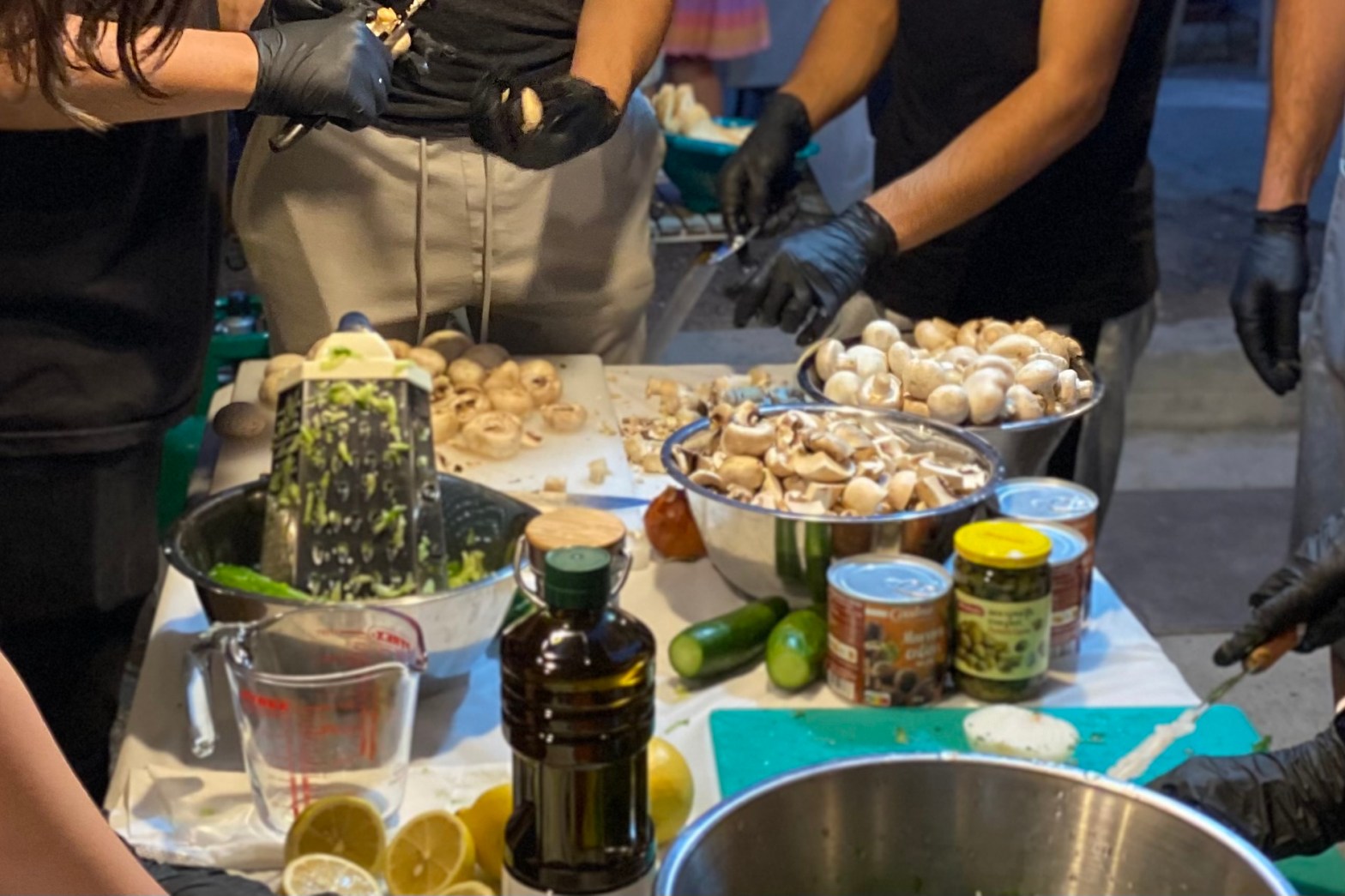
In February 2023 I ran a cooking workshop for the Goethe Institut Zypern as part of the Foodprint project. The title was Tangy: A celebration of citrus in Mediterranean cuisine. In preparation for the workshop, I jotted down the following preliminary thoughts. I hope someday to develop them into something more extensive, coherent and complete.
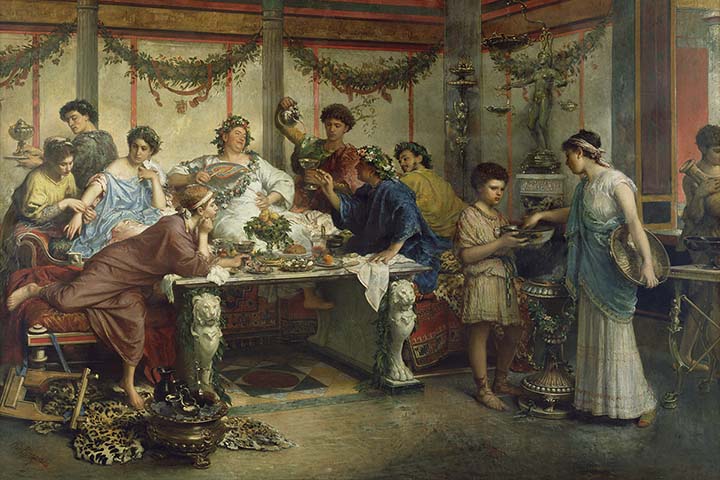
The dinner at the house of Trimalchio in Petronius’ Satyricon is to us, modern readers, otherworldly and perhaps a little frightening, not least because of the menu on offer:
A double pannier of olives, green and black, a gridiron of sausages, damsons and dormice coated with poppy seeds and honey. Fig-peckers in egg yolk seasoned with pepper in egg-shaped pastry. Hors d’oeuvres arranged per zodiac sign: ram’s vetches, beef, kidneys and lamb’s fry, the womb of an unfarrowed sow, an African fig a tart and a cake on the two pans of Libra’s balance, a small sea fish, a bull’s eye, a sea lobster, a goose, two mullets. A piece of cut sod, on which rested a honeycomb with the grass arranged around it. Another tray with stuffed capons and sows’ bellies, a hare with fitted wings. Whole wild boar accompanied by pastry suckling piglets and filled with live thrushes. A hog stuffed with sausages and meat puddings. A boiled calf wearing a helmet. Saffron-squirting cakes and fruits. Boneless fattened chickens served with pastry-capped goose eggs. Thrushes made out of pastry, stuffed with nuts and raisins, accompanied by quinces. A dish of pork dressed up to look like a fattened goose garnished with birds and fish. Water jugs with oysters and scallops to the brim accompanied by a gridiron of snails.
It is perfectly debauched, the recipes, the volume of food, the serving of each dish, and perfectly playful, an all-around experience that leaves the diners amused, scared, surprised, at times flabbergasted.
The components of the meal, however, are all too familiar. They are what we associate with the Mediterranean diet. Sure enough, the menu is heavy on the meat and the Mediterranean diet is thought of as mainly plant-based but Trimalchio’s dinner was a special occasion (the practice of reserving meat for rituals persists, if fainter, to our days) and there are also nuts and fruit, fresh and dried, honey, seafood. It’s not that the host could not afford anything more exotic – so rich was that whatever he desired he had imported from abroad, whether it be bees from Attica or mushroom seeds from India – but those were the ingredients of a feast, like those found in the garden of Alkínoös, the King of the Phaeacians.
To left and right, outside, he saw an orchard closed by a pale – four spacious acres planted with trees in bloom or weighted down for picking: pear trees, pomegranates, brilliant apples, luscious figs, and olives ripe and dark. Fruit never failed upon these trees: winter and summer time they bore, for through the year the breathing Westwind ripened all in turn − so one pear came to prime, and then another, and so with apples, figs, and the vine’s fruit empurpled in the royal vineyard there. Currants were dried at one end, on a platform bare to the sun, beyond the vintage arbors and vats the vintners trod; while near at hand were new barely formed as the green bloom fell, or half-ripe clusters, faintly coloring. After the vines came rows of vegetables of all the kinds that flourish in every season, and through the garden plots and orchard ran channels from one clear fountain, while another gushed through a pipe under the courtyard entrance to serve the house and all those who came for water. These were the gifts of heaven to Alkínoös.
There is no one Mediterranean diet any more than there is one Mediterranean culture; to argue the opposite amounts to imperialist essentialism, to orientalism. But this does not do away with the aporia, arguably first articulated by the anthropologist Fernand Braudel, that although we have a sense, perhaps some rather confidently, of what counts as Mediterranean, we can never quite describe what Mediterranean is. The same applies to cooking and eating. The differences from East to West and North to South are vast. Lebanese cuisine, say, is radically different to Italian, yet we would not hesitate to consider them both Mediterranean.
At the same time, if we go back a little further, all Mediterranean cuisines bear the whole of the basin in them. They are the long history of connection, communication, import and export. Once originated elsewhere, produce is now ubiquitous across the basin and native to several regions. It is also a history of violence. Empires were perhaps the most significant driving force for the establishment and spread of cultures and techniques. Or think of the Moriscos, who, on their violent expulsion from Spain, changed the culinary ways of the Maghreb.
The Mediterranean diet was (re)conceptualised and medicalised by Ancel Keys and his ground-breaking Seven Countries Study, launched in 1958, not as a diet that is uniform in its minute details but rather as a general nutritional pattern. For medical purposes, the Mediterranean diet is generally low in saturated fat – olive oil is its principal component of fat –, it is high in cereal products, legumes, fruit and vegetables, moderate in fish and low in dairy and meat products. Pared down to its elements, this idea of the Mediterranean diet, the idea that most people are familiar with, has been displaced, exported, simulated, assimilated. It has travelled across the globe.
PORTO STYLE TRIPE
One day, in a restaurant beyond time and space,
They served me love as cold tripe.
With utmost delicacy, I told the delegate from the kitchen:
I’d rather have it hot.
I told him tripe (and it was Porto style) is never eaten cold.
They got impatient with me.
You’re never right, not even in a restaurant.
I didn’t eat, I didn’t ask for anything else, I paid the bill,
Went outside, and walked up and down the street.
Who knows what this means?
I don’t know, and it happened to me.
(I know very well there was a garden in everyone’s childhood,
Private or public, or the neighbor’s,
I know very well our playing was its custodian,
And sadness is today’s.)
I know this many times over,
But if I asked for love, why did they bring me
Cold Porto style tripe?
It’s not a dish you can eat cold,
But they brought it cold.
I didn’t complain, but it was cold.
It should never be eaten cold, but it came cold.[1]
This is by Alvaro de Campos, one of the many aliases of Portuguese philosopher and poet Fernando Pessoa. Porto-style tripe[2] is meant to be served hot, having it offered to him cold leaves him disconnected with the world, it is like being denied the love that he craved and sought. The reason for this disconnect is not private or esoteric. How specific dishes are cooked and presented is a social practice and therefore subject to rules, it isn’t simply a matter of personal taste or preference, although it may of course be that in tandem. Being offered cold Porto-style tripe is an unjustifiable breach of the rule – variations are allowed, perhaps the cannellini beans can be substituted with butter beans, but only to a limit, with no one quite knowing where that limit lies until it is reached. The poet’s disconnect is social. The social practice, of which he wanted to be a part, is undermined and so is the community that generated it and sustains it. The restaurant is unembedded, it is “beyond time and space”.
The medical understanding of the Mediterranean diet cannot grasp its social nature, which necessarily resides in the context. In 2013, the Mediterranean diet was inscribed on the representative list of the intangible cultural heritage of the humanity by UNESCO, on the joint application of Cyprus, Croatia, Spain, Greece, Italy, Morocco, and Portugal.[3]
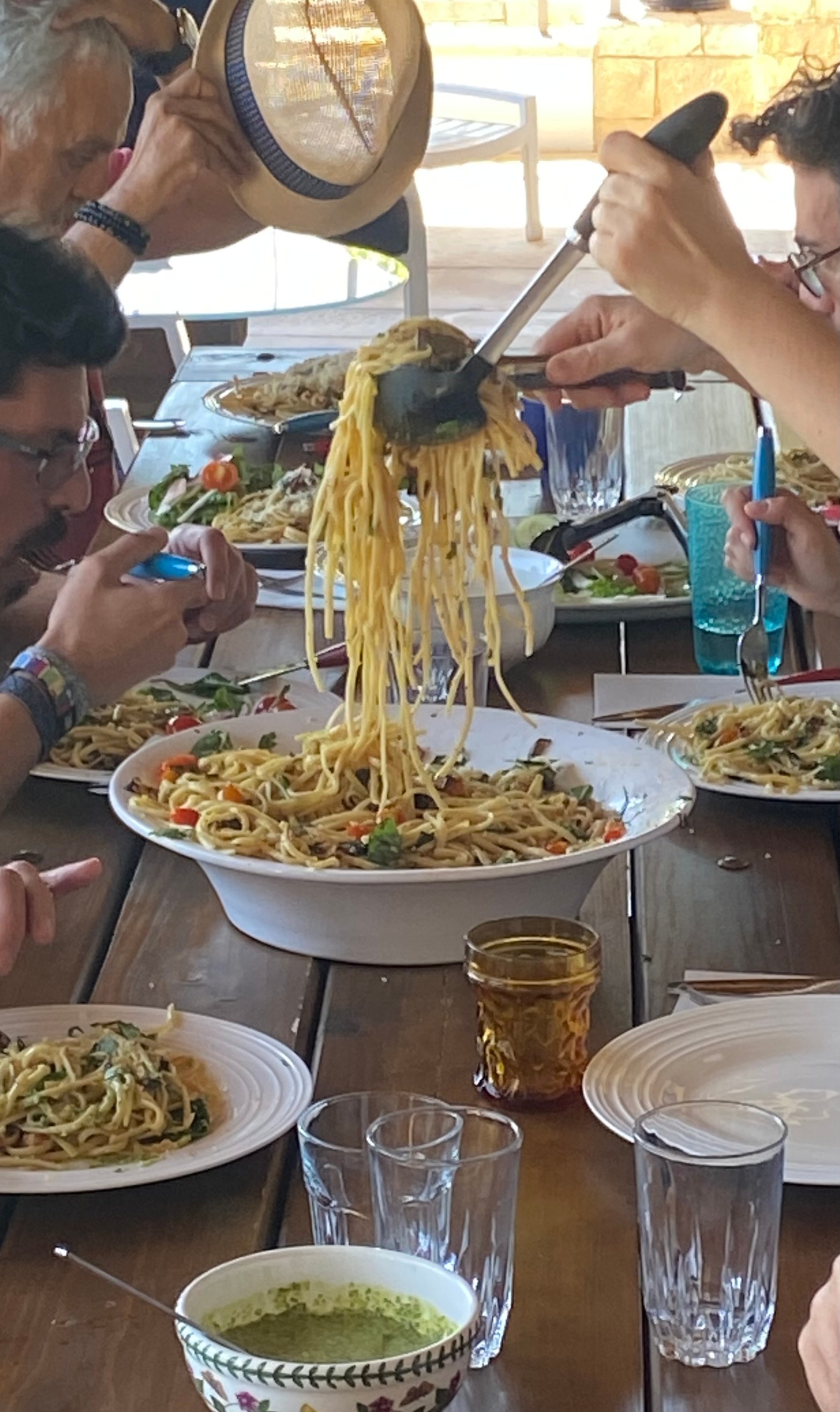
The Mediterranean diet involves a set of skills, knowledge, rituals, symbols and traditions concerning crops, harvesting, fishing, animal husbandry, conservation, processing, cooking, and particularly the sharing and consumption of food. Eating together is the foundation of the cultural identity and continuity of communities throughout the Mediterranean basin. It is a moment of social exchange and communication, an affirmation and renewal of family, group or community identity. The Mediterranean diet emphasizes values of hospitality, neighbourliness, intercultural dialogue and creativity, and a way of life guided by respect for diversity. It plays a vital role in cultural spaces, festivals and celebrations, bringing together people of all ages, conditions and social classes. It includes the craftsmanship and production of traditional receptacles for the transport, preservation and consumption of food, including ceramic plates and glasses. Women play an important role in transmitting knowledge of the Mediterranean diet: they safeguard its techniques, respect seasonal rhythms and festive events, and transmit the values of the element to new generations. Markets also play a key role as spaces for cultivating and transmitting the Mediterranean diet during the daily practice of exchange, agreement and mutual respect.”
In its medicalised conception, the Mediterranean diet can conceivably be administered by pills, say, or by injection without any remainder, because the connection it draws between the person and her diet is selective and instrumental. Indeed, it is more of a separation than a link, similar to the alienation between the consumer and the product she consumes.
UNESCO’s conception is designed to capture people’s relations to nature, both in its raw state and transformed through labour and skill, but also to their relations to each other as these are mediated by the use of nature.
The Mediterranean diet is a celebration of nature as well as a celebration of each other. In the Homeric epics, the numerous feasts are ways of connecting with the gods but, even more so, they are ways of connecting with the community, a community which is not predetermined but is constituted by the feast itself, by hospitality. Odysseus comes as a stranger to feasts, which are organised in his honour. [4] (Let’s pause and consider how we treat those who drift to our shores in need these days). The one example that stands out as wrong, as a corruption of the practice is the feasting of Penelope’s suitors. Predatory, rude, theftuous, and cruel as they are, their feasts are abominable, they are destructive of community.
It is for the same reason that the Mediterranean diet is radically at odds with neoliberal capitalism. It is cyclical and slow-paced, capitalism flattens time. It is about craft, capitalism is about automation. It is about continuity and, at the same time, surprise, variety and innovation, capitalism necessitates radical standardisation. It is small-scale, cooperative, capitalism is about the concentration of production and ownership. It is about locality, capitalism thrives on global distribution networks. The Mediterranean diet resists its commodification.
We should take the UNESCO conception of the Mediterranean diet as a reminder of the value of our practices. But we should also be aware of some risks that the contradictions and tensions intrinsic to it cause.
Like all institutions, this too has performative force, it brings into being a version of what it tries to capture. In doing so, it prescribes its object. This is, after all, part of its aim: to record and preserve cultural heritage and this can only be performed by being prescriptive and setting the standards against which practices will be measured.
This is neither unjustified nor undesirable so long as it remains external to the practice. Once it is imported into it with full normative force, rather than just as information to be fed back into the collective awareness of participants, then we might become disconnected from the practice itself, which needs to develop organically, on the basis of general guiding principles communally upheld and internalised, and not as a matter of external rules. Only so can it adapt and evolve on its own terms whether it be around the basin or, indeed, by communities outside it, as, for example, in the diaspora.
The kitchen. La cucina, the true mother country, this warm cave of the good witch deep in the desolate land of loneliness, with pots of sweet potions bubbling over the fire, a cavern of magic herbs, rosemary and thyme and sage and oregano, balm of lotus that brought sanity to lunatics, peace to troubled, joy to the joyless. (John Fante, Brotherhood of the Grape)
Doing something as a matter of external rule-following might also undermine something central to the very idea of the Mediterranean diet, which both the medicalised and the cultural heritage conceptions fail to capture: the pleasure that we take from it.
Let us return to the Satyricon, which, according to one interpretation might be named after the Latin ‘satura’, meaning a plate filled with various kinds of food, rather than the Greek-derived word ‘satyros’.
Seleucus, one of the diners at Trimalchio’s feast, has just been to the funeral of his friend Chrysanthus, who “slipped his wind”:
Why, only the other day he said good morning’ to me, and I almost think I’m talking to him now! God’s truth, we’re only blown-up bladders strutting around, we’re less than flies, for they have some good in them, but we’re only bubbles. And supposing he had not kept to such a low diet! Why, not a drop of water or a crumb of bread so much as passed his lips for five days; and yet he joined the majority! Too many doctors did away with him, or rather, his time had come, for a doctor’s not good for anything except for a consolation to your mind!
This is not to suggest that the Mediterranean way of eating necessarily entails a self-destructive jouissance but rather to emphasise that pleasure is resistant to rules outside of itself, and it is certainly not the outcome of rule-following, while, at the same time, it has itself the force to determine a social practice. Whether it be the joyfulness of abundance and sensory stimulation or the sense of emotional connectedness in mourning that eating the same meal – think of kollyva: wheat, sesame seeds, almonds, walnuts, cinnamon, sugar, pomegranate seeds, raisins, anise, parsley, the human condition, our common destiny in a bowl – to understand the Mediterranean diet without pleasure is to understand it in an impoverished manner. The question, then, which can only raised here, is how exactly the social rules that constitute the practice of the Mediterranean diet are reconciled with the pleasure that it offers.
Mediterranean peoples have been drifting away from the Mediterranean diet, this much is clear on the available evidence. The reasons for this are many and varied but, no doubt, it calls for self-reflection on a way of life that goes way beyond its nutritional value.
[1] The Collected Poems of Alvaro de Campos (1928-1935), Chris Daniels transl., Shearsman Books 2009.
[2] White beans and tripe, with olive oil, onion, garlic, bay leaf, chouriço and carrots. It ostensibly dates back to in the 14th century, when meat was reserved for the Portuguese army in Africa, which left Porto’s residents with the offal.
[3] https://ich.unesco.org/en/RL/mediterranean-diet-00884
Back to cooks home. Back to books home.
 Personal chef & catering in Cyprus | Author